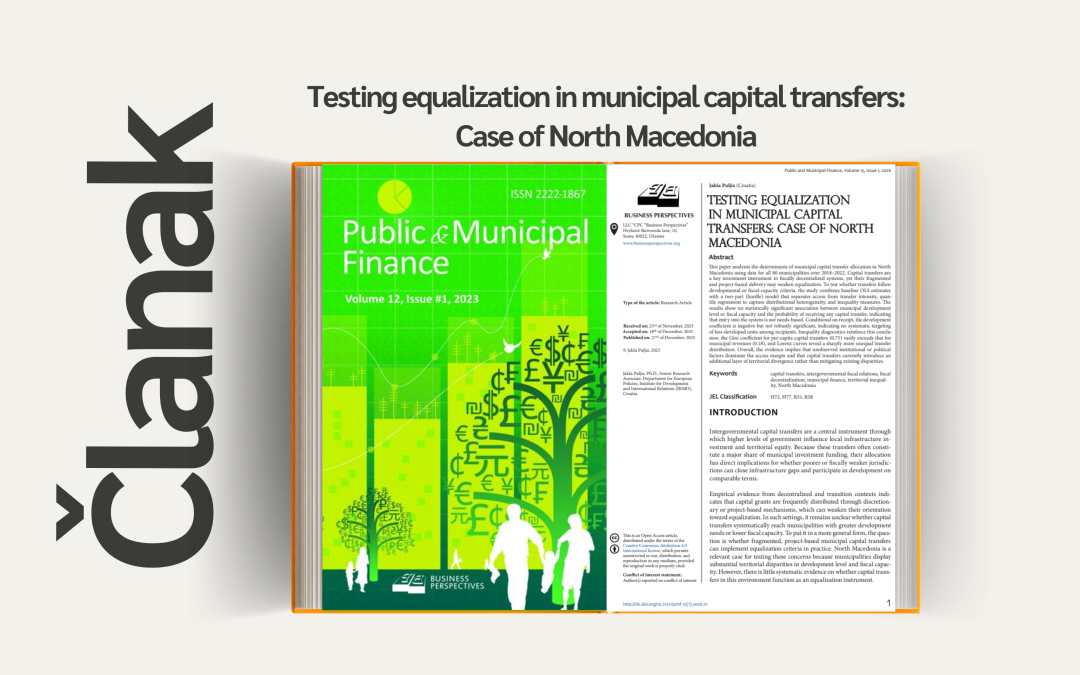
The Director of the Institute for Development and International Relations (IRMO), Jakša Puljiz, PhD, has published a new scientific paper titled “Testing equalization in municipal capital transfers: Case of North Macedonia” in the international journal Public and Municipal Finance.
The paper analyzes the determinants of capital transfer distribution to municipalities in North Macedonia, utilizing data for all 80 municipalities over the period from 2018 to 2022. As capital transfers are a vital instrument for local development, the study examines whether the current allocation model effectively reduces inequality among municipalities.
Key takeaways:
- Misalignment with development needs: The analysis reveals no significant correlation between a municipality’s fiscal capacity and the funding received. This indicates a systemic inefficiency, as public funds fail to target the municipalities that need them most to bridge the development gap.
- Risks of discretionary allocation: Instead of rule-based distribution, access to funds is driven by unobserved institutional factors. This highlights that ad-hoc, project-based allocation, without strict criteria, increases the risk of political bias and funding unpredictability.
- The case for objective criteria: The findings strongly suggest that reforming the system towards formula-based allocation and objective criteria is essential. Such a shift would enhance transparency and ensure that capital transfers fulfill their primary purpose of fostering balanced regional development rather than deepening territorial disparities.
The journal Public and Municipal Finance is indexed in relevant international databases (Scopus), and this paper contributes valuable insights for improving fiscal decentralization policies across Southeast Europe.
The full paper is available at the following link: Testing equalization in municipal capital transfers: Case of North Macedonia