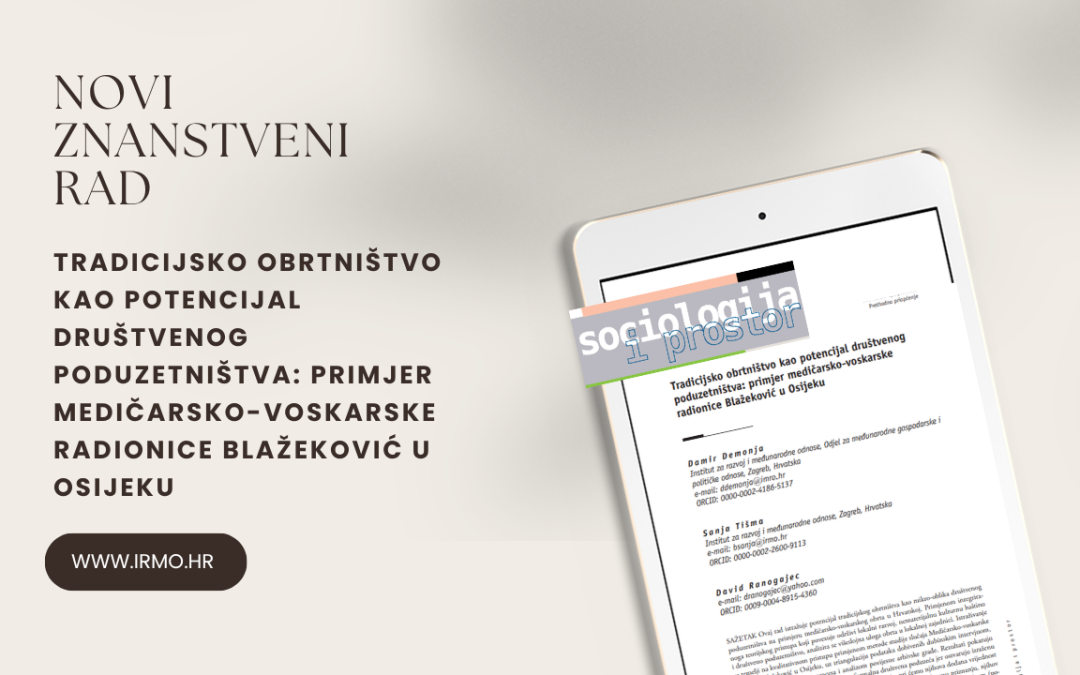
Damir Demonja, PhD, Scientific Advisor with tenure at the Institute for Development and International Relations (IRMO), Zagreb, together with Sanja Tišma, PhD, Scientific Advisor with tenure at the Institute for Development and International Relations (IRMO), Zagreb, and David Ranogajec, MA in Art Education, of the Blažeković Gingerbread and Candle-Making Workshop, Osijek, published a scientific paper categorised as a preliminary communication, entitled “Traditional Crafts as a Potential for Social Entrepreneurship: The Case of the Blažeković Gingerbread and Candle-Making Workshop in Osijek”, in the scientific journal “Sociologija i proctor”. The journal is indexed in the Scopus scientific database and is published by the Institute for Social Research in Zagreb.
Abstract
The paper investigates the potential of traditional crafts as a micro-form of social entrepreneurship through the case of the Blažeković gingerbread and candle-making workshop in Osijek. Using an integrated theoretical framework that brings together sustainable local development, intangible cultural heritage and social entrepreneurship, the authors examine the multiple social, cultural and economic roles that a traditional craft can perform within its local community.
The study employs a qualitative case-study approach. Data was collected through in-depth interviews with the workshop owner, observation of the production process, and analysis of historical archival material, internal documentation and publicly available sources. The findings indicate that traditional crafts, while generally not formally recognized as social enterprises, often fulfil an important social mission in practice: they preserve and transmit inherited knowledge and skills, contribute to local identity, sustain family-based continuity of work, and generate cultural value that goes beyond market exchange.
Special attention is given to the institutional and regulatory barriers affecting the survival of traditional crafts in Croatia. These include inadequate classification of activities, obstacles to operating and complying with fiscalisation requirements at fairs and religious festivals, restrictions related to family work, HACCP requirements, and the lack of educational and professional mechanisms for training new artisans. The paper concludes that the long-term sustainability of these crafts requires an integrated support framework linking cultural, economic, educational and social policies, with local communities taking an active role in protecting and co-creating craft development.
Keywords
Traditional craft; social entrepreneurship; intangible cultural heritage; gingerbread making; licitar; case study; local development; Croatia.