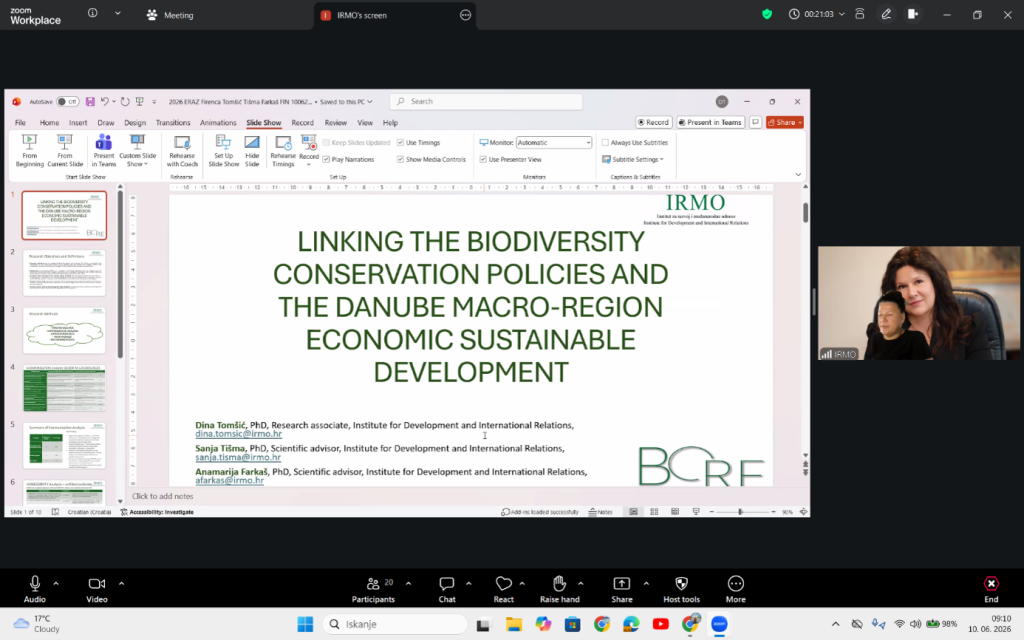
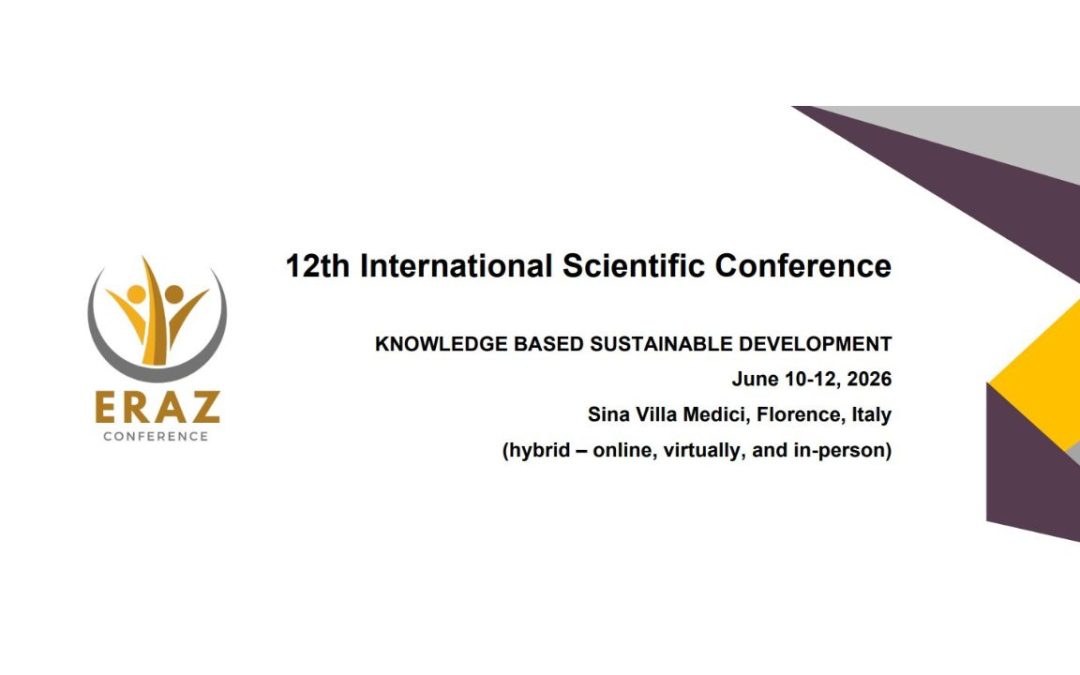
Dina Tomšić, Sanja Tišma, and Anamarija Farkaš participated in the international scientific conference “12th International Scientific Conference ERAZ 2026 – Knowledge Based Sustainable Development”, held in a hybrid format in Florence, Italy, from 10 to 12 June 2026. The conference was organized by UdEkom Balkans. More information about the conference programme is available at: https://eraz-conference.com/agenda/.
This year, more than 180 abstracts have been accepted for the Conference, signed by more than 310 authors from 36 different countries (Albania, Algeria, Argentina, Austria, Barbados, Bosnia and Herzegovina, Bulgaria, Croatia, Czech Republic, Ethiopia, France, Georgia, Germany, Ghana, Greece, India, Iraq, Italy, Japan, Jordan, Latvia, North Macedonia, Pakistan, Panama, Poland, Portugal, Qatar, Romania, Serbia, Slovakia, Slovenia, Spain, Türkiye, UAE, Ukraine).
On the first day of the conference, 10 June, the authors presented their paper entitled “Linking the Biodiversity Conservation Policies and the Danube Macro-Region Economic Sustainable Development.”
The paper examines the role of biodiversity conservation policies within the framework of the European Union Strategy for the Danube Region (EUSDR) and the EU Biodiversity Strategy for 2030 (EUBDS). Its objective is to identify opportunities for the sustainable economic integration of biodiversity conservation practices through the implementation of the EUSDR.
The study applies a compliance analysis to assess the level of alignment between Priority Area 6 – Biodiversity (PA6) of the EUSDR and two key policy documents that constitute the European Union’s biodiversity policy framework: the EU Biodiversity Strategy for 2030 and the European Green Deal.
The findings indicate a high degree of alignment between EUSDR Priority Area 6 and the EU Biodiversity Strategy for 2030. However, the analysis also reveals the absence of policies that effectively connect economic development, the financial sector, and biodiversity conservation.
Based on the findings, the authors propose several new mechanisms to bridge the identified implementation gaps, including the Biodiversity Flagship, the Danube Biodiversity Business Council, and the Biodiversity Web/Mobile Application, all aimed at strengthening the integration of biodiversity conservation into sustainable economic development within the Danube macro-region.