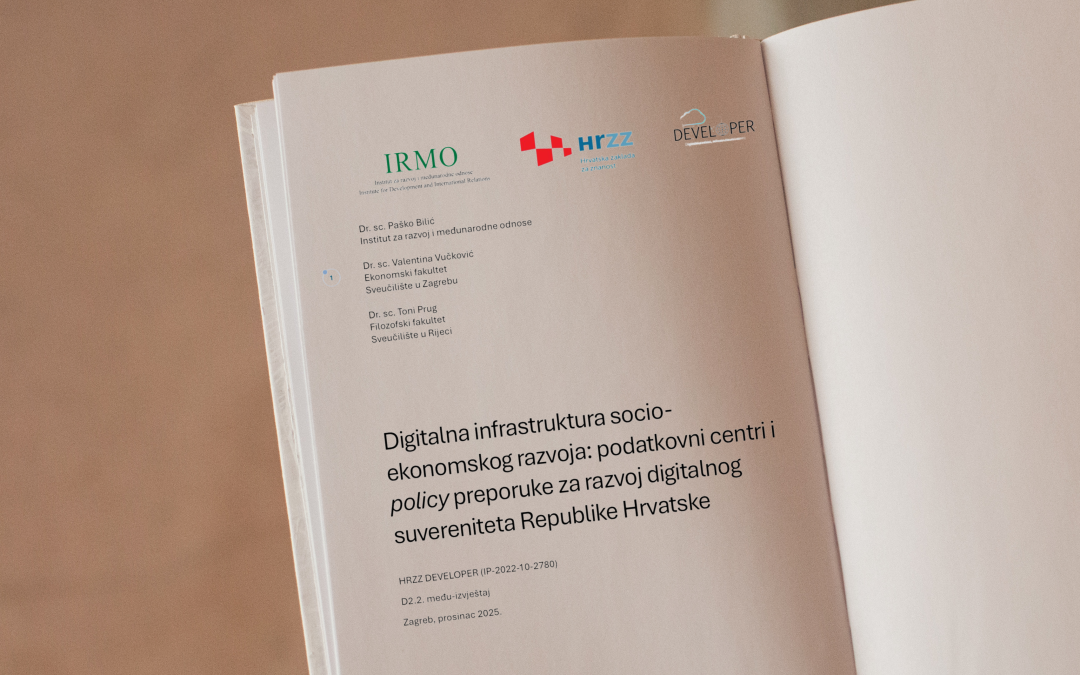
Paško Bilić, Valentina Vučković, and Toni Prug, researchers on the Croatian Science Foundation project Digital Data, Infrastructures and Development (DEVELOPER) [HRZZ IP-2022-10-2780], have published a report entitled Digital Infrastructure of Socio-Economic Development: Data Centres and Policy Recommendations for the Development of Digital Sovereignty in the Republic of Croatia.
The report analyses the role of digital infrastructure in the socio-economic development of the European Union and the Republic of Croatia, in the context of digital sovereignty, the energy transition, and institutional capacities. It is based on the premise that digital infrastructure is a necessary but not sufficient condition for development, and that its effects depend on states’ ability to translate infrastructure investments into broader social and economic benefits. At the EU level, the report highlights the intense concentration of data centres and cloud capacity among a small number of global providers, alongside ongoing efforts by the European Commission to promote decentralisation, energy efficiency, and strengthen European digital sovereignty through the Digital Decade policy framework. The empirical part of the report is based on a cluster analysis of EU Member States, which reveals significant differences in infrastructural coverage, institutional quality, and the level of digital “spillover” effects.
The results confirm that countries with developed institutions, advanced digital skills, and active industrial policies achieve higher social and economic returns from digital infrastructure. Croatia is among the countries with below-average spillovers, indicating limited capacity to translate infrastructure investments into development outcomes. In the national context, the report provides a detailed analysis of the legislative framework, the structure of public and private data centres, and the sector’s economic dynamics, characterised by revenue growth amid intense pressures from energy costs. For Croatia, an integrated development approach is crucial, one that links digital and energy policy, strengthens state capacities, fosters advanced digital skills, and ensures systematic monitoring of the social and economic impacts of digital infrastructure.