
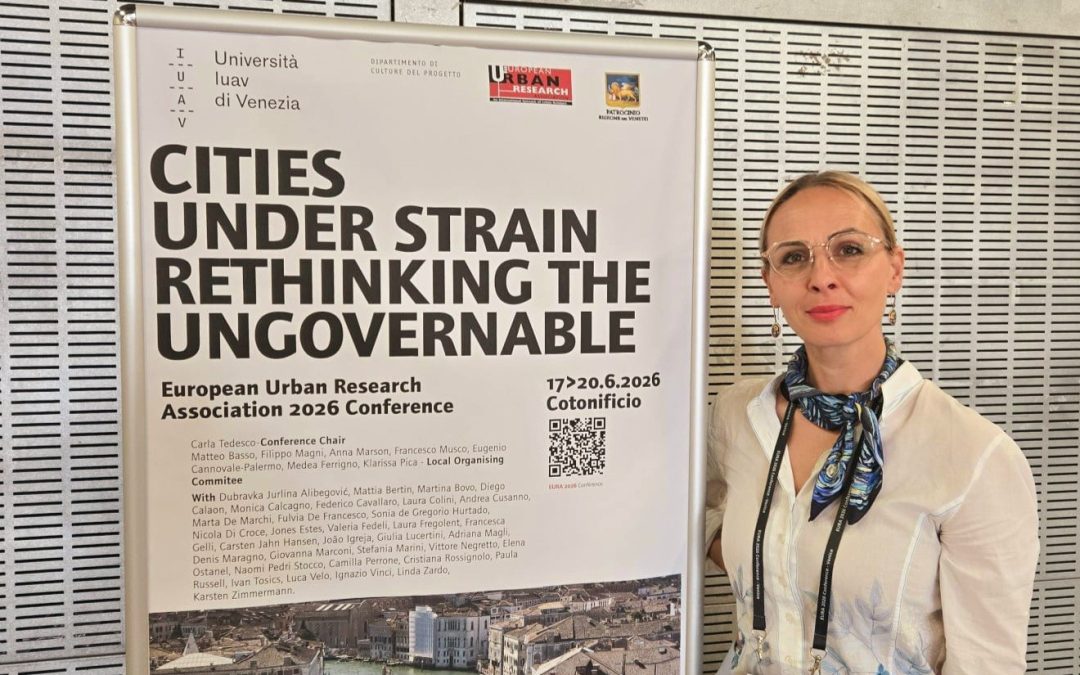
Ivana Keser participated in the international conference Cities under Strain: Rethinking the Ungovernable, held at Università Iuav di Venezia from 17 to 20 June 2026, under the auspices of the European Urban Research Association – EURA 2026.
At the conference, she presented the paper Navigating Urban Governance under Uncertainty: AI Literacy, Ethical Oversight, and Regulatory Readiness. The paper examines the preparedness of public administrations for the responsible integration of artificial intelligence into urban governance systems, with particular attention to institutional capacity, ethical oversight and regulatory readiness in the context of the European Union’s Artificial Intelligence Act.
The paper addresses the ways in which the increasing use of artificial intelligence in public administration is reshaping institutional capacities, decision-making processes and governance arrangements in cities and territories facing heightened uncertainty. Special attention is given to the challenges associated with climate change, socio-economic instability and complex multi-level urban issues, as well as to questions of accountability, transparency, democratic values and the preservation of meaningful human oversight in decision-making.
The analysis is based on original empirical research conducted within a national capacity-building programme on artificial intelligence for public institutions in Croatia, implemented by the State School for Public Administration. The study draws on survey data collected from 154 public officials representing ministries, public agencies, cities, counties and other public bodies, complemented by qualitative insights from structured workshop-based exercises.
The paper highlights uneven levels of AI literacy and institutional preparedness across public administration. It argues that the integration of artificial intelligence into urban governance should not be understood merely as a technical innovation, but as a broader socio-institutional transformation requiring organisational learning, regulatory compliance, ethical standards and clearly defined human responsibility.